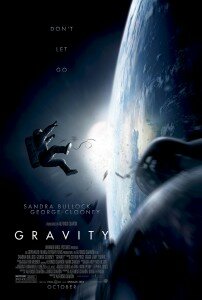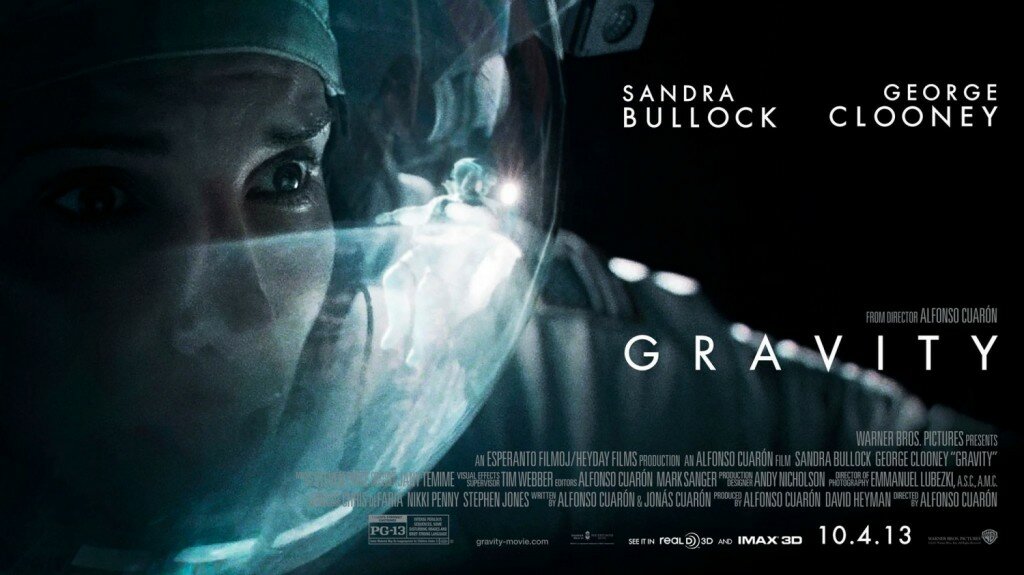
This film’s defenders and enthusiasts tend to insist that it needs to be seen in 3D, preferably in IMAX 3D, in order to be fully appreciated. What’s odd about such a claim is that it ultimately condemns the very film it seeks to praise, since arguing that the movie can only be fairly judged using parameters which fall outside those used to assess every other modern film, means admitting that this is not really, in the fullest and most commonly accepted sense, a ‘film’ at all. It’s more of a fairground entertainment of some sort, an immersive spectacle that seeks to offer more than a mere ‘moving picture’ but actually ends up delivering far less. Leaving aside the fact that cinema has its roots in exactly this sort of amusement park ride, the fundamental question remains: should this entertainment even be considered for an Academy Award? And what will its future be, once the theatrical runs peter out and the larger portion of its historical existence on disc, or digital download, begins?
So in fact it makes much more sense to jettison the 3D gimmickry, and consider the merits of ‘Gravity’ as a plain old film. As such, it has a lot going for it: state of the art technology, top-tier stars, enormous budget, big themes. Sadly, none of these elements can raise the film above mediocrity. And the double meaning of the title – referring not just to the weightlessness of space but also the grave danger the characters find themselves in – also threatens to collapse inwards, since the potentially serious thematic aspects (man’s predicament, alone in a Godless universe) are ignored in favour of thrills and spills.
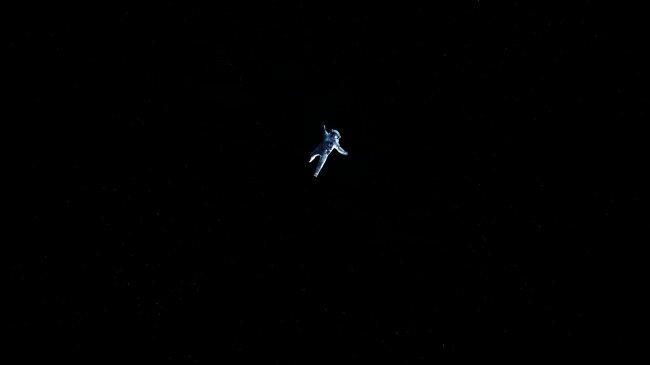
Some of the early scenes are promising. That’s not to say that the film starts well: although the visuals are good, the first couple of minutes of the soundtrack are given over to annoyingly inaudible conversation being exchanged between Earth, and the astronauts played by George Clooney and Sandra Bullock, as well as between those characters and a couple of hardly seen minor figures who will be conveniently killed off in short order, leaving us with a lot of cutesy chit chat between the major stars. The plot gets going about twenty minutes in, when the space shuttle around which George and Sandra had been working, is catastrophically damaged by space debris, leaving the two surviving astronauts stranded with diminishing oxygen supplies. George has a fancy new jet pack, presumably supplied by some sort of NASA version of James Bond’s ‘Q’, which allows him to go scooting around willy nilly; Sandra becomes detached and begins drifting helplessly into open space, spinning and tumbling and panicking as the remaining percentage of her oxygen supply heads into single figures. Rescue is at hand, though, in the form of Jet Set George, who comes blasting out to reel her back in. Anyone who has an existing aversion to George Clooney will find him hard to stomach here; this is far from his most subtle performance.
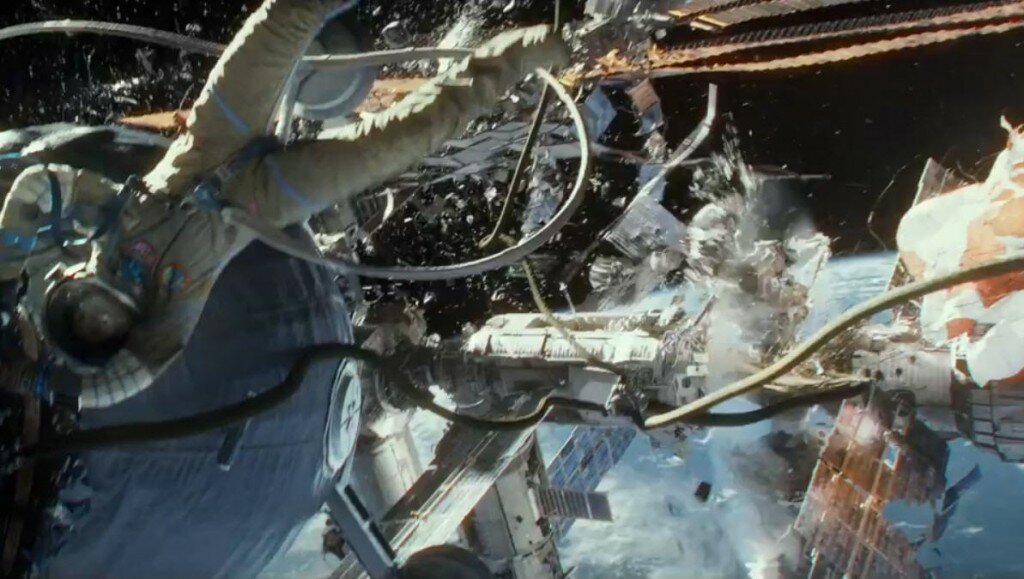
Anyway, so begins a series of mini crises, little cliff-hangers in the heavens, with each seemingly hopeful step towards a route back to terra firma interrupted by obstacles which are then duly overcome, the characters all the while evincing a puckish sense of humour about their perilous circumstances. “Clear skies, with a chance of space debris” quips Bullock at one stage, whist struggling through a situation that would have most of us wondering about the arrangements for waste disposal within our space suits.
Bullock, though, is made of sterner stuff, and despite having 0nly had six months’ rudimentary training (she’s a doctor, not a career astronaut) she is able to open airlocks on a variety of Russian and Chinese space stations, and can read the manuals and operate the controls inside them. There’s a twist concerning George Clooney’s character, around the one hour mark, which turns out not to be a twist at all; after this, the already fairly credulity-straining plot spirals into utter preposterousness, probably peaking at the point where Bullock uses a fire extinguisher to propel herself between a redundant escape pod (wouldn’t you know it, the fuel supply has run out, despite the pod never having been used), and the latest in a series of ‘last chance’ space stations.
But so what if the plot is silly? There’s no reason for the film not to work as an entertainment. What would Hitchcock have said about accusations of implausibility? No, the reason for the film’s failure lies with the script. Woeful dialogue predominates, and the story is just too corny and repetitive to offer any real sense of immersion or suspension of disbelief. Scene after scene plays out far too slowly, with lingering shots of not very much following each segment of obstacle circumvention. The decision to cut all contact with Earth, and keep it cut, probably was intended to generate a sense of heightened isolation; what it does, though, is rob of us of dialogue in the latter segments of the film. Bullock is left talking to herself, and this becomes increasingly inane.
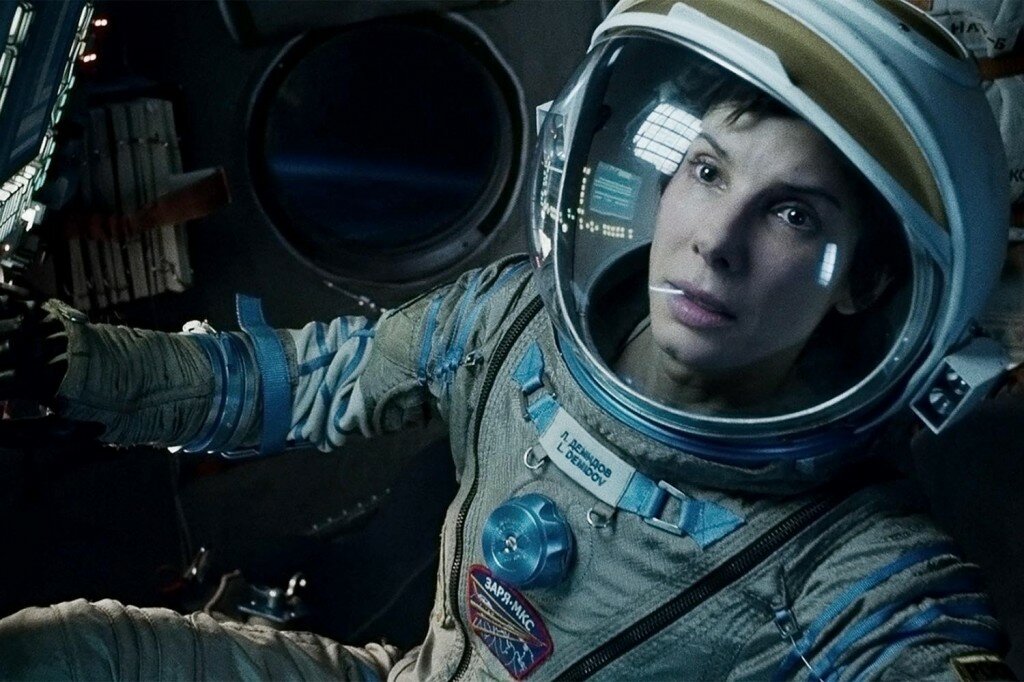
Overall, this is a film that relies not just on cumbersome presentation technology , but also on our pre-existting sense of wonder about space. This in itself is a further fatal flaw, since our wonder is exactly that: pre-existing. The film has nothing to add to the scenes we’ve seen so many times before: Earth viewed from space; vast emptiness; floating silence. As an entertainment, with all the thrills of IMAX, this may work well. As a film, it’s just ok. Bullock is fine; Clooney is slightly irritating. The script is under-written, the story is hokum. The running time, to be fair, is a pleasantly uninflated 90 minutes. There was an opportunity here to make a genuinely fresh movie set in space but foregoing all that dreary Sci-fi nonsense about aliens and evil empires, focusing instead on the much more interesting subject of the human race itself; that opportunity has been missed. The result is an ok entertainment, and a pretty poor film.